Wednesday, March 14, 2012

Another Photo Post

 My host family in our training community - César, Silka (my niece), Marcos (my brother, Silka's father - neither of them live in the house with us), and Reyna, my host mom. Oh - and Toby, the 6 month old puppy!

More photos of my house, as requested - my closet

Reyna cutting up a coconut! (what you see in the backround)

Finally at a beach! Near Rio Hato

My bed (not my packages)
 
 Another view of my room (above), the living room with the new tv

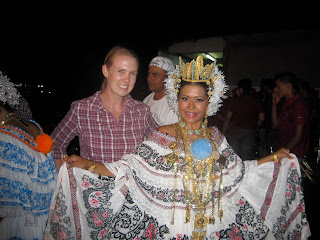
Arrival to my site - views of the Queen of the Sugar Cane Festival of 2011 on my first night


 Where they process the sugar cane before distilling it - the grounds are gorgeous

A carreta that is used to move sugar cane

More Princesas and their amazing outfits Saturday night

Reyna 2012

My counterpart and host brother pushing the sugar cane grinder around to make juice! It was delicious.

Carreta representing the different districts


Me with one of the Reynas!!

More photos to come soon...


Wednesday, March 7, 2012

Host family and community in Pesé

Right now I am living with a woman named Bruni (52), her daughter Susanna (24), and Susi's son, Roderick (8). I may stay with them for 3 months, or I may move in with another family. The other family lives a little ways out of town though, so that really depends on my ability to get transportation to school (especially during the rainy season), but I met them and saw their house, and I think I would be happy there. The man of the house (son of the woman who lives there) seems very nice and César says he’s very respectful, which I would appreciate. So we’ll see.

But as for my current host family, they are definitely a very different family than my host family in my training community. The one difference I noticed immediately – they are not used to having Americans around. I thought I had some adjustments when I first got here, but the families that we’ve been staying with so far have mostly had volunteers in the past. I am the 5th trainee that has stayed in Reyna and César’s house, so they have gotten used to some of the peculiarities of Americans. But this is a whole new experience for my new family.

It’s also a little bit difficult for me to figure out what is cultural/regional, and what is just particular to each family. Of course I know there are habitual differences between families in the US, so of course there are here as well. But the issue is that I don’t know the culture well enough to know what is what! In my new host family, they speak really loudly and try to talk over each other if they want to say something. My host mom also kind of tuts/hisses at me if she wants my attention or just uses hand signals to try to tell me things. But guess what – the hand signals are different than what we do in the US! So half of the time I don’t know what she’s trying to say. But I’m trying to be patient and ask her to speak slowly.

The accent here is a lot harder to understand than with my other host family as well. They drop SO MANY of their ‘s’ and ‘d’ sounds. But I’m learning quickly. I want to try to keep my Spanish proper though, so people can still understand me from other countries. I think their accent down here equates to a really strong southern/country accent from the states. Basically people from the country/small towns in any country around the world are hard to understand. But I’m getting better every day. I can basically follow conversations in real-time now! Woohoo! Big accomplishment

There are also a couple of people in the community that I’ve met and I really like. When I first arrived, one of Susi’s friends – Marta – was here at the house. Since then, I’ve seen her several more times and have gotten to know her. She is super sweet and I like her a lot. I hope we can become friends and hang out some – she’s about 27, so it will be nice to have some friends closer to my age! I also met a woman named Wendy who lived in the US for about 5 years and was married to an American and has 2 children (in their 20’s) who still live in the US, so she speaks great English and seems very willing to help me in any way she can. The last volunteer that was here in my site stayed with her, so she knows what PC is all about! There are also a ton of family members in Pesé – I can’t keep up with them all! Lots of cousins and extended family. I’m sure I’ll figure it all out eventually.

Coming down here has been a lot of ups and downs. I’ve had a couple of somewhat down days since being in Panama, but I’ve overall been really happy and been able to work through any issues I’ve had. But being around people who aren’t used to Americans, who are more difficult to understand, who have many different customs than I do (like personal space/voice level), and not being around all of the other people in PC Group 70 has been a big adjustment. I’ve had multiple mood swings per day – one moment I’ll be really happy, then a couple of hours later I’ll be a little upset and frustrated. But each day is a little better by adjusting to things.

I’m coming to appreciate our training community and families more and more and and starting to learn that this is the reality of a PCV’s life. But I’m still happy to be here overall. Pesé is absolutely gorgeous – it is my favorite city in Panama so far, and I am soooo lucky in that. The people are also really nice – I just need to get to know them! And they me. So it will take time. And I’ve got 2 years of it!

Some awesome things that Pesé has:
Bank branch – even though it’s not my bank, at least I know I can get cash if I seriously need it immediately

Bus stations – (don’t get a big fancy idea of this in your head. It just means that there are places where buses leave) direct buses to Panama City which take about 4 hours, and buses to surrounding communities

Parks – there are 3 parks that I have seen so far – one is in the middle of town and just has some benches and green area, one is a playground and a basketball court and some benches, and the third just has a few benches and a little playground. It’s nice for the community to have these places though. And they are all in good repair!

Center for children with disabilities – Anita, the wife of the regional deputy (Popi), is the president of an association that helps children who have learning disabilities such as ADD. This is such a wonderful community asset, and I hope that they are taking advantage of it. I hope to be able to promote this during my time here.

Free internet! My community has free internet throughout the town! I can’t get it in my bedroom (the ciderblock walls probably have something to do with that), but if I go out on the porch, it works great! Such a wonderful resource!!

Schools and my job

I will be working with both the primary school (kindergarden through 6th grade) and the secondary school (7th grade through 12th grade). They divide their secondary school into 2 parts much like we do with middle school/high school. 7th – 9th is ‘intermedio’ and then 10th-12th is when they have to pick a specialty. The school in Pesé has specialties in business and enterprise. There are 4 English teachers in the primary school and 7 in the secondary school. I’m planning on trying to work with 2 per week so that I can be accessible and in the classroom, but also rotating through all of them in a somewhat timely manner.

The primary school starts at 7:20 and ends at 12:45 with a 15 minute break about 9:30. Classes are 45 minutes long, but don’t have time in-between like we do in the US, so classes never start exactly when they are supposed to. But this is just taken for granted and worked around. The secondary school functions in much the same way, but there are 2 different sessions or ‘turnos’ – one from 7:00 – 12:15 and the other from 12:45 – 6:00. This system is in place because there are too many kids to all go to school at one time, the infrastructure is not big enough. But I think this is a good solution to keep the class sizes manageable. The schools are pretty nice as well; the high school is well kept-up and has computers (though one of the computer rooms is never used because there is not enough electricity to sustain it), a library, science labs, and even a Home-Ec and a Shop-like class room (woodworking etc). The lower school is also well-kept and the classrooms are decorated and have cute curtains. The classrooms don’t have air-conditioning, but with the frequent wind here, it makes it bearable.

I asked for the teachers’ schedules so that I could figure out when I could work with who. I drafted a tentative plan for working with the primary school teachers, and I’ll be working 6 out of 7 periods every day, which is a lot, but I want to give each of the teachers equal time and I want to be able to see each of their classes an equal number of times per week (or at least as close as I can get). When I showed my schedule to César, he asked “You’re going to work this much? Do you plan to die young?” haha. But we’ll see. It’s really just a temporary schedule for the first few weeks so that I can get a feel for the schools and how I can best contribute.

National Sugar Cane Festival

The National Sugar Cane Festival is held every year in Pesé. As mentioned in my previous post, this region is covered with fields of sugar cane, and seco is the liquor that is made from distilling sugar cane and largest seco factory in Panama (owned by the Vice President of the country) is in Pesé. So every year in the beginning of March a long weekend is devoted to the National Sugar Cane Festival. I arrived just in time for the beginning of it on Thursday.

Each year there is a Queen of the Sugar Cane Festival and on Thursday, the queen from last year is paraded through the streets to the stage, 4 other princesses are introduced that represent different aspects of culture (dance, food, dress, customs – I think), then 2 little girls come up with a new crown and then the new queen for the current year is presented. The outfits and floats are like what you see in Carnaval celebrations – really elaborate, colorful and beautiful.

Friday brought more parades I think, though I didn’t end up going. Then Saturday evening was the biggest parade with 3 different floats. The first had the queen for next year, the second had the 4 princesses and the last one had this year’s queen.

Sunday was the parade of the carretas – little carts that are extensively decorated (though not like the floats) by each of the corrigimientos of the district of Pesé. They compete for a cash prize. Many of them are sponsored by politicians. Then at the end of the night the queen and the princesses are presented one more time.

Another sugar-cane related thing that I did this week was I got to taste sugar cane juice! My counterpart, César, took me and my family (we were on our way to swim in a river) to his friend’s house who has a mill/grinder/juicer – I don’t quite know what to call it. You normally hook up a horse to it, then feed the sugar cane through as the horse walks in a circle. Someone has to hold a funnel and bucket/bottle to catch the juice as well. They feed the sugar cane through twice to get all of the juice out. César also brought some ginger to add to it, which was delicious. They also make a honey out of it which we also got to try – it was SUPER rich. It had a slightly different taste than honey from bees, but was very good. This was such a cool experience to have – watching them make the juice, then drinking it! Felt very Panamanian!

I've been trying to add photos.... but they're not uploading. I'll add some when I can!

Tuesday, March 6, 2012

Arrival to Site! Part 1

Where to start… I think I’m going to break this week up into bits & pieces because there is so much to say! Let’s start with the Community Entry Conference, my counterpart and the town where I’ll be working.

The entire TE group went to Rio Hato in Coclé to the Centre de Desarollo Sustenible del Ambiente // Center for Sustainable Environmental Development aka CEDESAM (Panamanians like their acronyms). We arrived on Wednesday afternoon after a morning of packing/doing the last few things in our training community. A group of us walked quickly down to the beach where we ran into the water which felt GREAT. That is until we realized there were a bunch of tiny little jellyfish in the water that at first just kind of itched, but then when one really got you it would hurt a bit. But it was beautiful either way.

Then we went back, got dressed, then had dinner and met our counterparts! Our counterparts at the representatives from our communities that came to meet us and go with us back to our sites. My counterpart is César and he is the coordinator for the English department at the colegio – 7th-12th grades (see previous post for explanation of school system). He is nice and speaks pretty good English, so that was a comfort. We also had meetings the next day – as is typical of PC, then just as the CEC folks were arriving at CEDESAM we took off! César drove us back to our town, along with Miranda, another volunteer who is only 20 minutes away from me, and her counterpart, José. It took about 2 and a half hours to go from Rio Hato to Pesé.

We passed so many sugar cane fields on the way. My town is famous for 2 major things: seco (alcohol) and a Good Friday re-enactment. The largest seco factory in the country is in Pesé and it is owned by the vice-president of Panama. I haven’t yet gone inside the factory, but I did get to see the place where they process the sugar cane for the liquor. It was really interesting and I got a half-tour even though I wasn’t supposed to because I’m new and special haha.

César also took me, and my host family, to his friend’s home where they have a mill for sugar cane that produces juice. Normally the hook up a horse to turn the mill, but César and the two young boys just pushed it. They feed the raw sugar cane in, and juice comes out! It was absolutely delicious. César also brought some ginger to add to it, which gave it an amazing flavor.

As for the Good Friday re-enactment, it’s a whole event that goes on the entire week preceding Easter – called Semana Santa (Holy Week). I’m looking forward to it because everyone tells me that it’s beautiful. The main event is the re-enactment of the Last Supper through the crucifixion of Christ.

But the town and district of Pesé is beautiful – there are rolling hills, beaches not too far away, trees lining the streets, and my town is pretty clean! It seems to be a pretty well-off town in general. It seems that everyone has running water and electricity and my host family even has a big tv and a Wii. Certainly brings up the question in my mind – why would they place a PCV here? But it is becoming more and more clear that the English teachers could use the help, and English is such an important language for Panamanians. They have made it their second official language, and with all of the international tourism and business, it’s becoming more and more important. People who can speak English have many more opportunities than those who do not. 

More to come and I'll put up photos once I get them onto my computer. 

Sav